
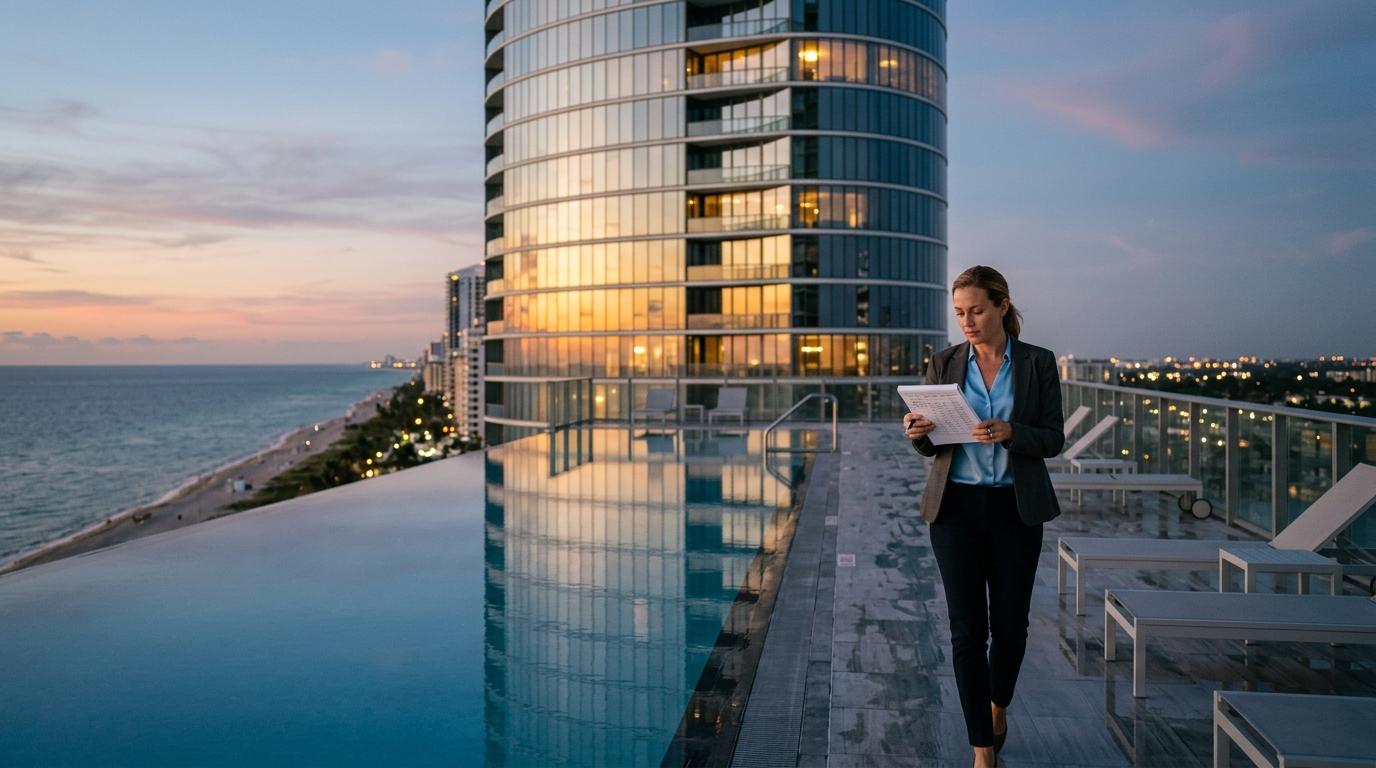
Analyzing Cap Rates for Miami Luxury Condos: A 2026 Investor's Guide
Cap Rates for Miami Luxury Condos in 2026: What Investors Need to Know
Cap rates for Miami luxury condos in 2026 range from approximately 3.5% to 5.2%, depending on the submarket, building age, and rental strategy. New development condos in Sunny Isles Beach and Brickell typically land at the lower end of that range, while established buildings in Bal Harbour and Bay Harbor Islands with stable rental histories can push toward the higher end. Understanding why that spread exists, and how to position within it, is the central task for any serious investor entering Miami's high-end residential market this year.
What Cap Rate Actually Measures in a Luxury Context
The capitalization rate is net operating income divided by current market value. For a luxury condo generating $180,000 in annual gross rental income with $60,000 in operating expenses, the NOI is $120,000. If the unit is valued at $3,000,000, the cap rate is 4.0%. Simple arithmetic, but the variables inside that formula are where luxury properties diverge sharply from conventional residential assets.
Operating expenses for Miami luxury condos are structurally higher than the market average. Monthly HOA fees in premier buildings such as Porsche Design Tower, Residences by Armani/Casa, or the St. Regis Residences routinely run $3,000–$8,000 per month. Property taxes in Miami-Dade County apply the Save Our Homes exemption only to primary residences; investment condos are reassessed closer to market value, which on a $3M unit can produce an annual tax bill of $45,000–$60,000. Add management fees of 10%–20% for short-term or seasonal rentals, and the expense ratio for a luxury condo can reach 35%–45% of gross income. An investor who models expenses at the standard 25%–30% assumption will significantly overstate NOI and, therefore, the investment's true yield.
New Development Condos vs. Established Resale Buildings: A Cap Rate Comparison
The decision between a pre-construction or recently delivered unit and a stabilized resale property has direct, quantifiable consequences for cap rate performance. The table below outlines the key structural differences an investor should model before committing capital.
| Factor | New Development Condo (2024–2026 delivery) | Established Resale Building (10+ years old) |
|---|---|---|
| Typical cap rate range | 3.2%–4.0% | 4.0%–5.2% |
| Purchase price premium | 15%–25% above comparable resale | Baseline market value |
| HOA fee stability | Low initial fees; subject to increase after developer subsidy period ends | Established reserves; fees are known and auditable |
| Rental income Day 1 | Zero; income starts only after closing and furnishing | Can be immediate if unit is tenant-occupied or furnished |
| Appreciation upside | Higher if project delivers on brand and amenity promises | Moderate; tied to neighborhood trajectory |
| Short-term rental eligibility | Often built-in; many new towers include hotel-operated programs | Governed by existing condo association rules; restrictions vary |
| Financing availability | Limited pre-construction lender options; larger cash deposits required | Conventional and portfolio lending widely available |
The practical takeaway: new development condos are not yield instruments at acquisition. They are appreciation plays with an income component that materializes over time. Investors expecting to service debt from rental income in year one of a new development purchase will face a cash flow gap that needs to be modeled explicitly and funded from reserves.
Submarket Analysis: Where Cap Rates Diverge in Miami-Dade
Miami-Dade County is not a single luxury market. Rental demand, seasonal occupancy patterns, and buyer profiles vary enough between neighborhoods that cap rate benchmarks should be applied at the submarket level, not county-wide.
Sunny Isles Beach has the highest concentration of new ultra-luxury tower deliveries in 2025 and 2026. Supply absorption is a real pressure here. Buildings competing for the same seasonal tenant pool means asking rents have softened 6%–9% from their 2023 peak, even as purchase prices have held. Cap rates consequently sit near the lower bound of 3.5%–4.2% for newer inventory. Investors in Sunny Isles are pricing in longer-term appreciation and brand premium, not current yield.
Brickell and the Brickell Key area attract a professional rental tenant base with longer lease terms. Annual unfurnished leases at the $8,000–$14,000 per month range produce more predictable NOI with lower turnover costs than furnished seasonal models. Cap rates in this corridor run 4.0%–4.8%, and the stabilized cash flow profile makes these units more financeable with institutional lenders.
Bal Harbour and Surfside offer a constrained supply environment. Land is genuinely scarce, and the zoning and political environment limits new tower development at the heights and densities seen elsewhere in Miami-Dade. Resale units in the Bal Harbour Towers building or new boutique projects in Surfside command premium rents from high-net-worth seasonal tenants, and low vacancy rates support cap rates of 4.2%–5.0% on well-managed units.
Miami Beach (Mid-Beach and South Beach) has the most complex regulatory environment. Short-term rental regulations have tightened substantially since 2022. Investors must verify the specific building's rental eligibility, minimum lease terms, and whether the unit qualifies for a short-term rental license under Miami Beach's current ordinance before underwriting income. Compliance failures can eliminate income entirely. When properly structured, cap rates here range from 3.8%–5.2%, with furnished seasonal units at the high end of that range.
The ROI Picture Beyond Cap Rate: What High-Net-Worth Investors Are Actually Tracking
Cap rate is a useful acquisition-day snapshot, but affluent investors in Miami luxury real estate are tracking a broader return metric. Total ROI for a Miami luxury condo investment incorporates four components that cap rate alone does not capture.
- Cash-on-cash return: For leveraged purchases, the actual cash yield on equity deployed. A 4.0% cap rate on a property purchased with 40% equity and a 6.5% mortgage rate may produce a cash-on-cash return of 2.1%–2.8%. Know the number before you close.
- Appreciation: Miami luxury waterfront properties delivered average annual price appreciation of 7.2% between 2019 and 2024, according to Miami-Dade County property records analysis. Appreciation does not appear in a cap rate calculation but is the primary driver of total return in the luxury segment.
- Tax efficiency: Depreciation deductions on investment condos can shelter a meaningful portion of rental income from federal taxation. A $3M condo with land valued at $750,000 carries a depreciable basis of $2.25M, which at straight-line 27.5-year depreciation produces approximately $81,800 in annual depreciation. Investors should verify the precise tax treatment with a CPA familiar with Miami real estate.
- Portfolio liquidity: Miami luxury condos retain an active secondary market supported by international buyer demand. Properties in branded buildings or on direct waterfront can sell within 60–120 days when priced correctly, giving the portfolio a liquidity characteristic that hard assets in other markets often lack.
Off-Market Opportunities and the Pricing Advantage They Create
Published MLS data captures the visible market. In Miami's luxury segment, a significant volume of transactions, particularly above $5M, occurs off-market through broker networks. Off-market condos typically transact at 3%–8% below comparable listed properties, directly improving the acquisition cap rate from the first day of ownership. Access to these opportunities depends on relationships with listing agents who specialize in the luxury tier and who receive pocket listing assignments from sellers who prioritize confidentiality and speed over maximum exposure.
For investors, the calculus is straightforward: a $4M unit acquired off-market at $3.75M with the same NOI produces a cap rate of 4.27% instead of 4.0%. That 27-basis-point improvement compounds significantly over a five-to-seven-year hold, and it comes without any change to the property itself. Identifying and transacting on off-market inventory is one of the highest-leverage activities an investor can pursue in this market.
Miami Luxury Condo Cap Rate FAQ
What is a good cap rate for a Miami luxury condo in 2026?
A cap rate of 4.0%–5.0% is considered solid for stabilized luxury condo investments in Miami-Dade County in 2026. Rates above 5.0% are achievable in specific submarkets or with furnished seasonal rental strategies, but require careful expense modeling. Rates below 4.0% are common in new development or ultra-premium buildings where investors are pricing in appreciation rather than yield.
Do new development condos in Miami generate good rental income immediately?
No. New development condos do not generate rental income until after closing, furnishing, and lease-up, a process that typically takes three to nine months post-delivery. Investors should budget for this income-free period and avoid underwriting debt service against first-year rental income in pre-construction purchases.
How do HOA fees affect cap rate calculations for luxury condos?
HOA fees are an operating expense that directly reduces NOI and therefore compresses cap rate. In premier Miami luxury buildings, HOA fees of $3,000–$8,000 per month represent $36,000–$96,000 in annual expenses. Failing to include these in underwriting is the most common modeling error made by investors new to the Miami luxury condo segment.
What Miami neighborhoods offer the highest cap rates for luxury residential investment?
Bal Harbour, Surfside, and the Brickell corridor currently offer the strongest risk-adjusted cap rates for luxury condo investors, with stabilized assets achieving 4.2%–5.2%. Sunny Isles Beach offers higher appreciation potential but lower current yields due to elevated new supply. Miami Beach carries regulatory complexity that must be fully underwritten before comparing its yields to other submarkets.
How does off-market acquisition affect cap rate in Miami luxury real estate?
Buying off-market at a 3%–8% discount to comparable listed properties directly improves the acquisition cap rate by improving the denominator (purchase price) without changing the numerator (NOI). On a $4M asset, an off-market discount of 6% reduces the purchase price to $3.76M and improves a 4.0% cap rate to approximately 4.26%, a meaningful yield enhancement that compounds over a multi-year hold period.